
How We Built a Scalable Partner Program with Kiflo: From Strategy to Operating System
The real challenge is not finding partners, but scaling them
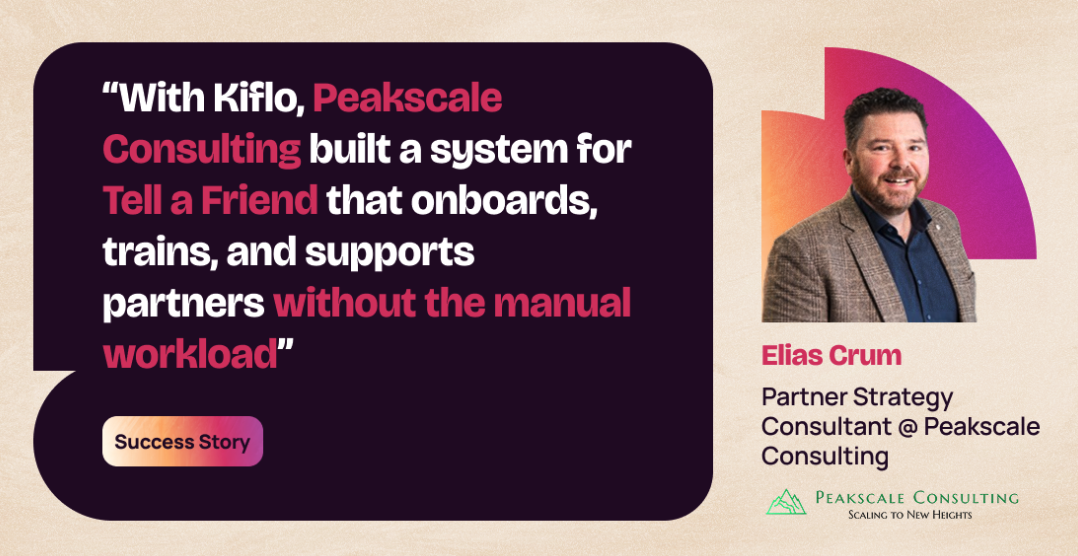
Most companies do not really have a partner problem. They have a partner system problem. The first few resellers, referral partners or agencies can usually be managed through personal contact, email, shared folders and a spreadsheet. That works surprisingly well until the network begins to grow. Then one partner has completed the training while another has not, someone registers a deal by email, an outdated sales deck is still being used and nobody has a clear picture of which partners are actively creating opportunities. At that point, the partner strategy that was meant to create leverage starts creating more work. At Peakscale Consulting, we believe this is exactly the moment companies should avoid. A scalable partner channel should be designed before complexity arrives, not after. Our recent work with Tell a Friend, using Kiflo as the underlying Partner Relationship Management platform, is a good example of how strategy, process and technology can be combined into one operating model.
Designing the partner journey before choosing the technology
Tell a Friend is a privacy-first referral marketing platform for retailers and consumer brands. Rather than relying only on a traditional direct sales model, the company chose to build a significant part of its growth through resellers and partners. When Peakscale became involved in May 2026, that strategy was clear, but the operational model still needed to be built. There were no mature processes yet for onboarding, training, deal registration, partner activation, content sharing or performance management. In many ways that was an ideal starting point because we did not first have to dismantle a patchwork of spreadsheets and manual routines. Instead, we could design the partner journey from the ground up.
We first mapped what a successful reseller journey should look like: how partners are recruited, what happens after they sign, what they need to learn, when they are considered commercially ready, how opportunities are registered, when the channel team should intervene and how onboarding ultimately turns into joint marketing and revenue. Only after those questions had been answered did we start thinking about software. That order matters. A PRM does not create your partner strategy; it makes a good partner strategy repeatable.
Why we selected Kiflo
Kiflo was selected because Tell a Friend did not simply need another CRM. A CRM remains important for customers and internal sales processes, but partner sales introduces an additional layer. You need visibility into partner organizations, individual contacts, onboarding status, training, opportunities, documents, tasks and activity, while partners themselves need a dedicated environment where they can work with you without becoming users of all your internal systems.
Kiflo gave us that structure. We configured the platform around a clear partner journey, including partner records, deal registration, pipeline management, document sharing, tasks and reporting. Just as importantly, it became a central operating environment where both Tell a Friend and its resellers can see what should happen next. Instead of asking whether somebody followed up with a reseller, the status is visible. Instead of searching through email for an opportunity, it appears in the pipeline. Instead of requesting the latest commercial materials, partners can access them themselves. Technology did not replace the operating model; it gave the operating model a place to live.
Turning onboarding from a bottleneck into a scalable process
One of the biggest improvements came from redesigning onboarding. In many early partner programs, onboarding is highly personal and time-consuming. That feels valuable at first, but it quickly creates a ceiling on growth. If every reseller requires eight hours of direct involvement from the internal team, adding thirty partners also means adding hundreds of hours of onboarding work.
We therefore separated the parts of onboarding that genuinely require personal interaction from the parts that can be standardized. Within Kiflo, we created a structured onboarding flow that includes kickoff, agreement, training, certification and co-marketing planning. We also built a Partner Academy consisting of around ten short videos covering the Tell a Friend proposition, the platform, use cases, competitive positioning and the practical sales process. Partners can work through this content at their own pace, while direct contact can be reserved for strategic questions, live opportunities and joint commercial activity. As a result, hands-on onboarding time has fallen from approximately eight hours per partner to around one hour, while roughly 75% of the onboarding journey has become automated or self-service.
Certification as the bridge from signed partner to active partner
Certification became another important part of the process. Signing an agreement does not make someone an active partner, and neither does attending an introductory call. A partner only becomes commercially useful when they understand the proposition well enough to identify the right opportunities, explain the value to prospects and know how to move a deal forward.
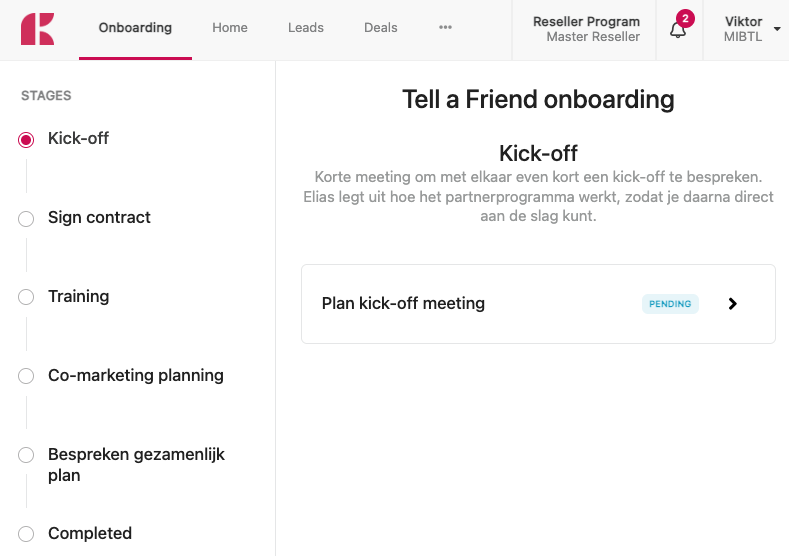
Certification creates a clear milestone between signing up and becoming sales-ready. It also gives the channel team better information. A partner that signed six weeks ago but has not completed the Academy requires a different intervention from a certified reseller that has already registered three opportunities. This creates a more objective way to manage partner activation and helps prevent relationships from becoming passive after the initial enthusiasm of signing.
Building co-marketing into the partner model from day one
The same thinking applies to co-marketing. In many partner programs, marketing comes later. First the partner signs, then training follows, and at some point someone may discuss a webinar, campaign or joint event. We wanted partner activation to start much earlier.
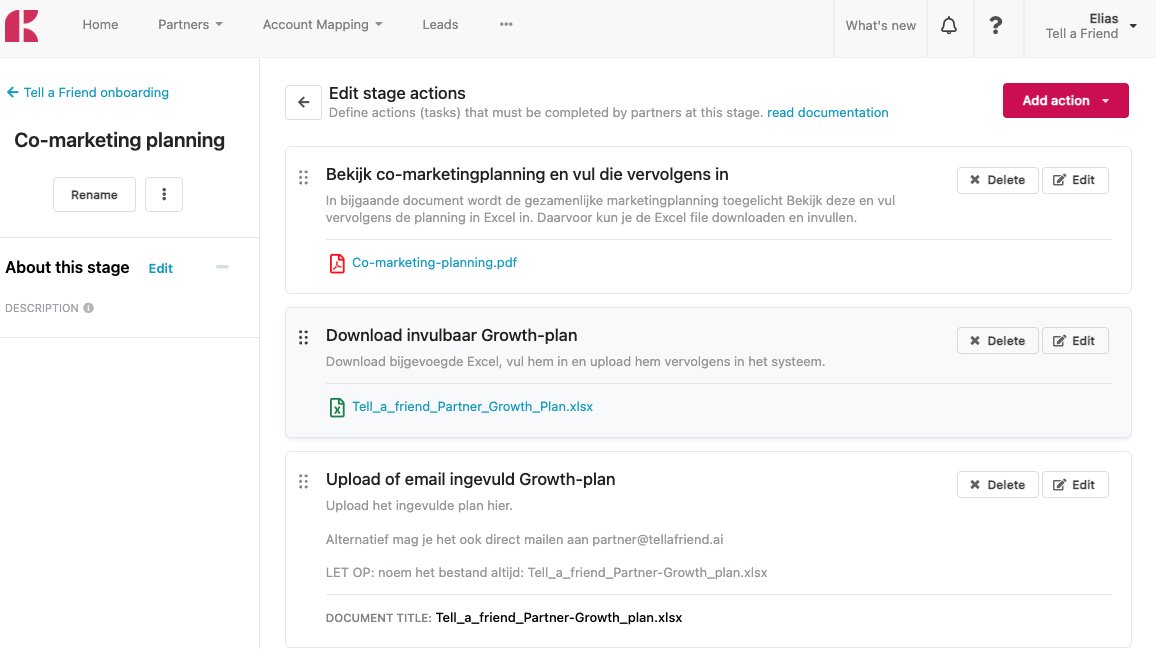
That is why we built co-marketing planning directly into the onboarding journey. Every reseller should leave onboarding with a concrete idea of how Tell a Friend and the partner will jointly create demand, whether through customer outreach, content, events, roadshows or another activity that fits their business. The objective is not to collect signed reseller agreements. It is to create commercially active partners.
Better visibility changes the way you manage partners
As the partner base grows, visibility becomes increasingly important. Without structured data, channel managers often spend most of their time with the partners who contact them most. But the loudest partner is not necessarily the most promising partner.
By bringing onboarding, activity, opportunities and pipeline information together, we can start asking better questions. Which partners are progressing? Who has completed certification? Who is registering opportunities? Where are deals getting stuck? Which newly signed partner has become inactive? Who may need help with their first campaign? That moves partner management from reactive relationship management toward proactive partner development.
Early results: less manual work, more scalability
The early results show why this structure matters. Tell a Friend started without an active reseller network and is now onboarding its first group of partners, with further partners entering the process each month and a target of building toward around thirty partners in 2027. Approximately thirty partner-related leads and opportunities have already been registered.
At the same time, the amount of manual onboarding work has dropped substantially, around 75% of the onboarding process has become automated or self-service, certification has been introduced and co-marketing has become a standard part of partner activation. For me, however, the most important outcome is not a single number. It is that the infrastructure can now handle the next partner and the one after that without requiring the internal organization to grow at exactly the same pace. That is the point of scalable growth.
Technology only works when the commercial model is clear
The project has also reinforced something we see repeatedly in B2B companies: technology works best when the commercial process behind it is clear. Buying HubSpot does not automatically create a strong sales organization, buying marketing automation does not automatically create demand and buying a PRM does not automatically create a successful partner ecosystem.
Companies still need to decide who their ideal partners are, why those partners should work with them, how they make money, what is expected of them, how onboarding works, what defines activation and how performance is measured. At Peakscale, this is the part we focus on. We help companies design the partner proposition, recruitment model, onboarding journey, enablement, certification, pipeline processes, co-marketing approach and performance structure. Platforms such as Kiflo then make that model operational and scalable.
Build the machine before increasing the volume
There is a broader scaling lesson in this. Companies often wait too long to introduce structure. When there are only three salespeople, they postpone sales operations. When there are only a handful of partners, they postpone partner operations. That works until growth arrives, at which point the company is forced to redesign its processes while simultaneously managing the very growth those processes should support.
We prefer the opposite approach: build the machine before increasing the volume. That is what we have been able to do with Tell a Friend and Kiflo. The partner network is still in an early growth phase, but the operating model has been designed around where the business wants to go rather than where it started.
Are you adding partners, or building a system that can scale them?
For companies that expect resellers, agencies, distributors, referral partners or technology partners to become an important part of growth, this is the key question to ask. Are you merely adding partners, or are you building a system that can scale them?
At Peakscale Consulting, we help B2B and technology companies design, launch and scale partner-led growth programs, from partner strategy and program design to PRM selection, implementation, onboarding and ongoing channel operations. Because a strong partner program should not create more work every time another partner joins. It should create leverage.
👉 Curious how your company can improve its partner strategy? Book a free entry call with Peakscale Consulting today.